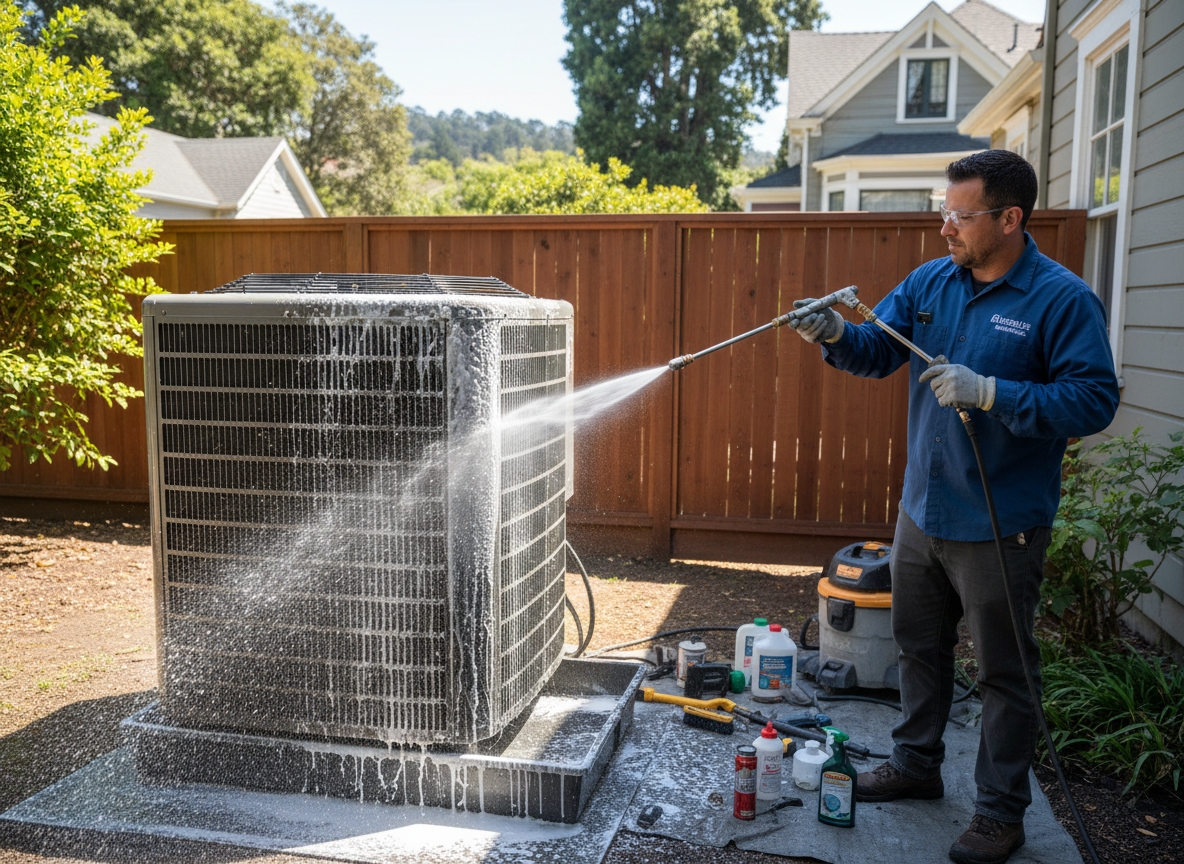
Coil cleaning HVAC targets both evaporator and condenser coils where dust, pollen, and moisture combine in Union County homes. Berkeley Heights properties built in the 1960s through 1980s often have tighter mechanical closets that trap debris against fins, reducing heat transfer and forcing the system to run longer cycles. Technicians use non-acidic foaming agents followed by low-pressure rinsing to avoid bending aluminum fins common on older Carrier and Trane units found along Snyder Avenue and Plainfield Road.
Summer humidity in the Berkeley area accelerates mold growth on evaporator coils once temperatures stay above 80 degrees for consecutive weeks. This growth releases spores into the supply ducts, which is why coil cleaning HVAC is frequently paired with air duct cleaning routes that serve the same neighborhoods. Neglected coils also ice over during shoulder seasons when overnight lows drop quickly, a pattern seen in the Watchung foothills microclimate.
Seasonal Timing
Schedule coil cleaning HVAC before Memorial Day and again after Labor Day to match the pollen peaks and leaf-drop periods that load filters and coils in Berkeley Heights. Homeowners on streets with mature oaks notice heavier organic debris entering through condenser units placed close to ground level.
Access Challenges
Split-level layouts common near the address at 295 Snyder Ave limit side access to indoor coils, requiring mirror-and-brush techniques rather than full removal. This adds time but prevents damage to surrounding drywall and insulation typical in these homes.
Technician insight
In Berkeley Heights the thing that catches most people out with coil cleaning hvac is the 1970s split-level homes where the evaporator sits behind a finished closet wall with only a six-inch access cutout, so you end up doing the whole job with a mirror and angled brushes instead of pulling the coil.
Tight Access Coil Job on Plainfield Road
Homeowner reported weak airflow and musty smell after a humid stretch. We found heavy pollen and dust packed against the evaporator fins inside a narrow mechanical closet. Using foam and low-pressure rinse through the limited opening, we restored the temperature split without removing drywall. Airflow improved and the odor was gone on restart.
How it works
- 1
System Inspection
Technician examines coil condition, notes fin damage, and checks for standing water or mold visible through the access panel.
- 2
Protective Setup
Floor coverings and plastic sheeting are placed to contain runoff before any cleaning agents are applied.
- 3
Foam Application
Non-acidic coil cleaner is applied to both sides of the evaporator coil and allowed to dwell, breaking down pollen and dust layers.
- 4
Rinse and Dry
Low-pressure water rinse removes loosened debris; coils are dried with compressed air to prevent immediate re-wetting.
- 5
Final Check
System is restarted and temperature differential is measured to confirm restored airflow across the cleaned coils.
Pricing
Cost depends on unit age, coil accessibility, and degree of buildup; 24/7 scheduling available from the Berkeley Heights base.