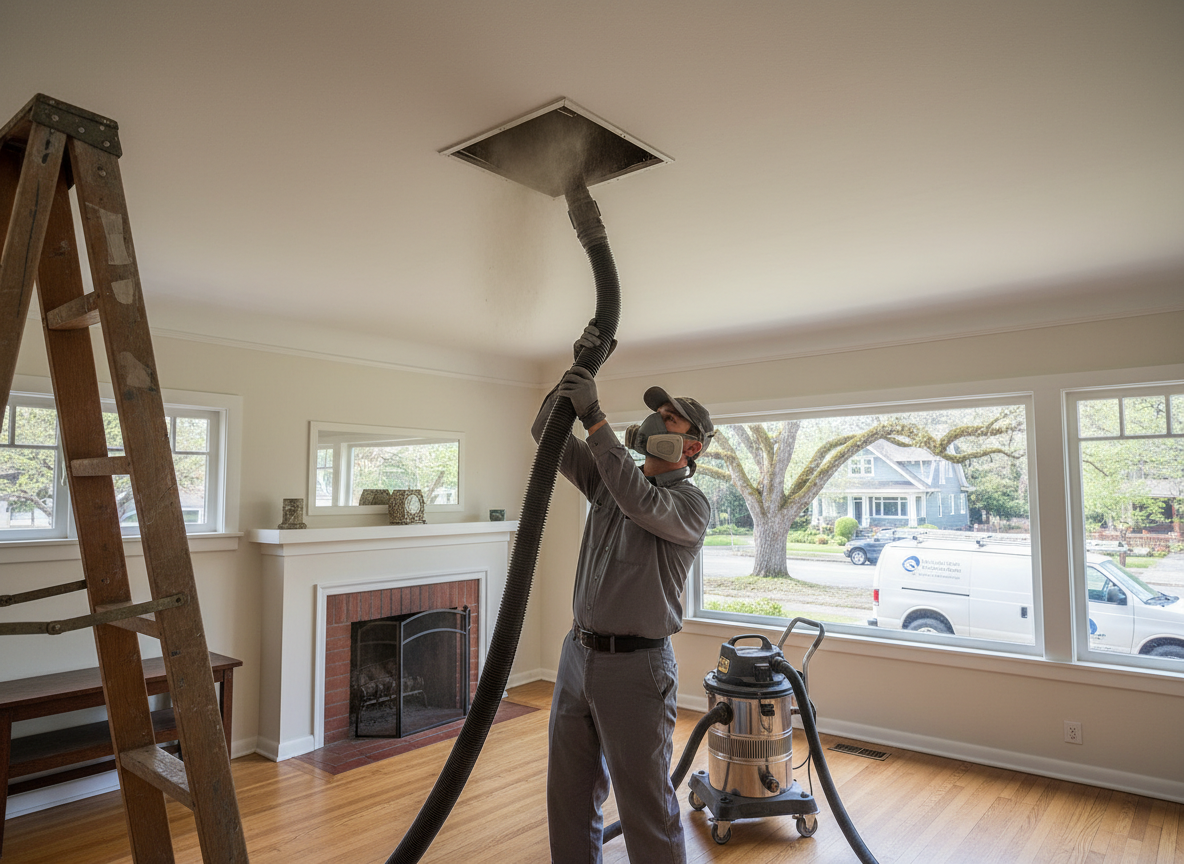
Berkeley Heights homes often feature older forced-air systems with sheet-metal or flex ducts running through basements and attics. Seasonal temperature swings cause condensation inside the lines, trapping pollen and fine road dust that drifts in from nearby Route 78 corridors. A thorough cleaning removes this buildup before it recirculates, especially in split-level houses common along Snyder Avenue where access panels are frequently hidden behind finished walls.
Edge cases appear in two-story colonials near the Watchung Reservation where main trunks sit above finished ceilings. Negative-pressure equipment must be staged carefully to avoid pulling insulation into the airstream. Homeowners sometimes attempt DIY vacuum attachments that dislodge but do not extract debris, leaving heavier particles to settle back into the supply runs once the system restarts.
We begin every job with a camera inspection to map actual duct layout rather than relying on original blueprints that rarely match renovations done over the past thirty years. This step reveals collapsed flex sections and missing dampers that would otherwise turn a standard cleaning into repeated callbacks.
After cleaning we reinstall all registers and test static pressure at the furnace to confirm airflow has returned to design levels. This final check prevents the common complaint of weaker heating after service in homes with older blowers.
Technician insight
In Berkeley Heights the thing that catches most people out with duct cleaning services near me is the number of 1960s and 1970s split-levels where the main return sits in a finished closet with no access panel. Homeowners assume we can just pull from the furnace, but we end up cutting a new opening that must be patched afterward.
Hidden Return in a Snyder Avenue Split-Level
The homeowner called after noticing uneven heating on the upper floor. Camera inspection showed the main return trunk partially blocked by insulation that had fallen through an unsealed joint above the finished closet. We opened a small access panel, extracted the debris, resealed the joint, and restored balanced airflow without disturbing the drywall finish.
How it works
- 1
Initial Camera Inspection
We scope every accessible trunk and branch to locate restrictions and document conditions before any equipment enters the system.
- 2
Negative Pressure Setup
High-powered vacuums are connected at the furnace and each supply run is isolated to pull debris outward rather than pushing it through the home.
- 3
Mechanical Agitation
Rotating brushes and compressed air whips dislodge caked material from duct walls while the vacuum captures it at the source.
- 4
Register and Vent Cleaning
All grilles are removed, washed, and reinstalled after the main lines are clear to prevent recontamination.
- 5
Post-Cleaning Verification
A second camera pass confirms debris removal and static pressure readings are taken to verify system performance.
Pricing
Pricing depends on number of supply runs, accessibility of trunk lines, and whether flex duct sections require replacement.