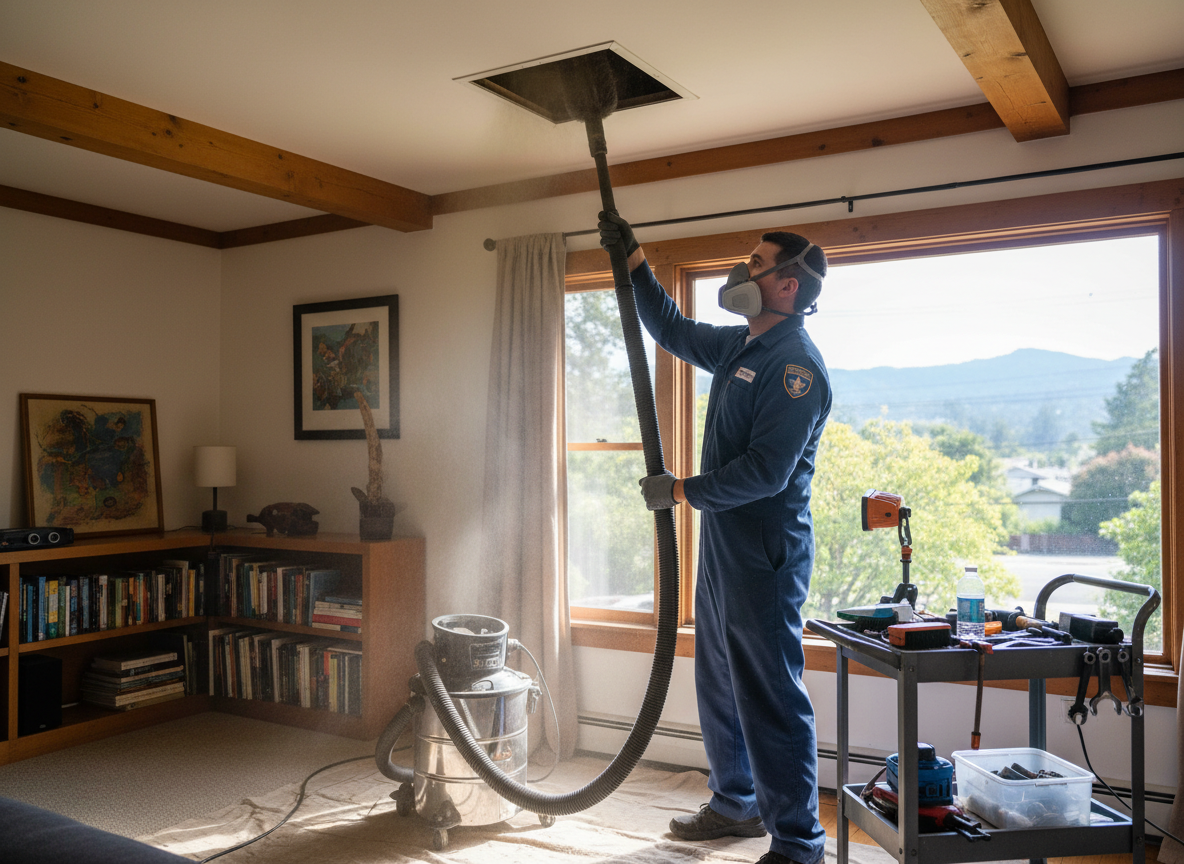
Berkeley Township homes often feature original duct runs from the 1970s and 1980s that run through crawl spaces and attics where salt-laden air accelerates corrosion on metal joints. When these seams loosen, fine beach sand and pollen enter the system and settle in the supply trunks. Standard shop-vac attachments cannot reach the far branches without collapsing flex lines, so technicians use a negative-pressure machine with rotating brushes sized for 6-inch and 8-inch ducts common in ranch layouts here.
High summer humidity combined with the frequent on-off cycling of central air creates condensation inside return plenums. This moisture mixes with dust to form a biofilm that restricts airflow and feeds mold colonies near the evaporator coil. Cleaning crews isolate the coil section first, then fog an EPA-registered sanitizer through the main trunk before brushing each branch to prevent regrowth during the next humid season.
Edge cases appear in split-level homes near Toms River where the duct chase runs through exterior walls. These lines collect rainwater seepage during nor'easters, rusting dampers and creating musty odors that travel room to room. The work requires removing the register boots, vacuuming the wall cavity, and replacing any damaged damper hardware before resealing to keep conditioned air from leaking into the wall.
After the cleaning pass, airflow is measured at each supply to confirm the system returns to original design volume. Homeowners are shown the before-and-after camera footage so they can see the material removed and understand why the job takes longer in older Berkeley properties than in newer construction.
Technician insight
In Berkeley, the thing that catches most people out with local air duct cleaning is the salt air that corrodes the original metal elbows in 1970s ranch homes; once those joints leak, pollen and sand keep re-entering no matter how often the filter is changed.
Rusted Elbows Near the Bay
A Berkeley Township homeowner called after noticing uneven cooling on the second floor. Inspection showed rusted elbows in the attic run allowing beach sand to enter the supply lines. Crew isolated the affected sections, brushed and sealed the joints, then verified restored airflow throughout the house.
How it works
- 1
Initial Walk-Through
Technician inspects every accessible register, return, and the air handler location while noting home age, duct material, and any visible moisture stains.
- 2
System Isolation
Registers are sealed and a negative-pressure unit is attached to the main trunk to contain debris during brushing.
- 3
Mechanical Cleaning
Rotating brushes and compressed air whips dislodge debris from trunk lines and branch runs; material is pulled into the collection unit.
- 4
Sanitizing and Final Check
Coil and plenum receive targeted treatment, then airflow is retested at multiple points before registers are reinstalled.
Pricing
Cost varies with number of supply runs, duct material condition, and whether the air handler sits in a tight attic or crawl space.